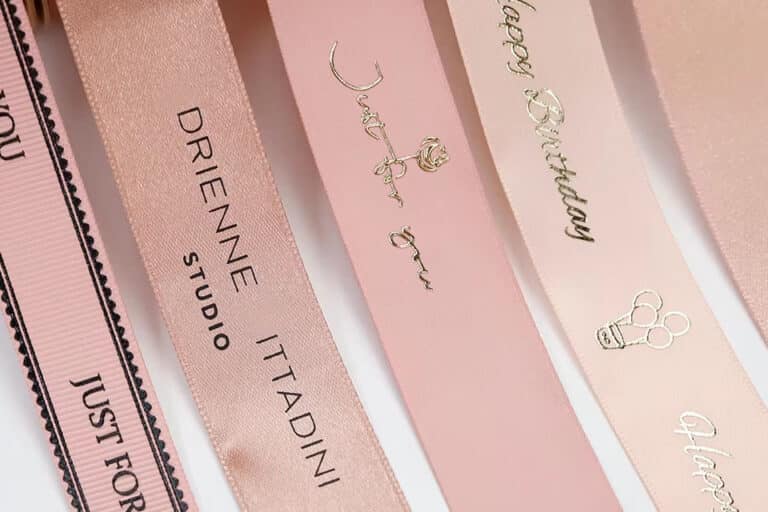
MEEDEE Ribbon is a B2B ribbon manufacturer in Xiamen, China, with 20+ years of OEM and ODM ribbon manufacturing experience.
Expert Review
This article was reviewed by the MEEDEE Ribbon editorial team.
View full profile
A · Application
Drape, bow structure, handling
C · Compatibility
Print, edge, packing, actual sample
E · Evidence
Signed revision, quote, owner, date
FACE means Finish, Application, Compatibility, and Evidence. Use the first two gates to shortlist satin or grosgrain, then require print and packing compatibility on production material and keep the final choice under one signed revision.
Worked approval-record example — ribbon calligraphy
This ribbon calligraphy record is an illustrative workflow, not a customer result or test report.
Order definition
Candidate A; use case, width, rib, color, and finish recorded
Proof attached
Handling or bow sample plus print and packing evidence
Decision
Hold until the sample works in the intended packaging application
Commercial release
Confirm quantity, schedule, and reorder reference after sign-off
How to write calligraphy on ribbon
At the How to write calligraphy on ribbon checkpoint, keep each ribbon calligraphy requirement beside its supplier proof and approval owner.
Does the supplier have a documented proofing process for calligraphy-style text on satin or grosgrain? Calligraphy requires precise ink adhesion and edge definition; a proofing step catches defects before bulk production. Supplier provides a digital or physical proof with approval sign-off before production release. Without proofing, the final print may show smudging, uneven curves, or poor contrast on the ribbon texture. Ask for a proofing workflow description and a sample proof from a previous calligraphy order.What is the standard lead time for a calligraphy-printed ribbon order from artwork approval to shipment? Lead time affects production scheduling and inventory planning; calligraphy may require longer setup. Supplier quotes 2–4 weeks for standard production after sample approval, subject to material and customization confirmation. Underestimating lead time causes stockouts or rushed approvals that compromise print quality. Confirm the lead time for your specific ribbon width, ink type, and quantity before placing the order.How does the supplier verify ink adhesion and wash fastness on satin versus grosgrain ribbon? Satin and grosgrain have different surface textures; adhesion and durability vary by material. Supplier describes a rub test or wash test with acceptance criteria for each ribbon type. Ink may flake or fade after handling or light exposure, causing returns or brand damage. Request a test report or sample that shows ink performance after the intended use cycle.What is the supplier's process for handling artwork file errors or color mismatch in calligraphy orders? Artwork errors are common; a clear correction process prevents delays and cost overruns. Supplier offers a free artwork review and one revision round before production begins. Unclear correction terms lead to extra charges, rejected proofs, or production of incorrect text. Document the artwork approval and revision policy in the purchase order or quality agreement.
Compare the available methods and their limitations
Option
Best fit
Trade-off
Risk to avoid
Verification
Follow-up
Current specification
Satin ribbon with solvent-based ink
High ink adhesion but requires ventilation and longer drying
Ink bleed or smudge if ribbon tension and drying time are not controlled
Inspect the buyer-approved sample quantity at the agreed production speed and record every observed bleed or smudge
Document drying time and tension settings in the work instruction
Alternative specification
Grosgrain ribbon with water-based pigment
Lower cost per yard but may require heat-setting for wash resistance
Color fastness failure if heat-setting temperature is not verified
Request a wash-test sample per the buyer-approved shade standard before bulk approval
Confirm heat-setting temperature and dwell time with the factory
Custom option
Pre-treated ribbon with primer layer for calligraphy
Higher material cost but reduces ink feathering and improves line sharpness
Primer compatibility with the selected ink type may not be tested
Run a buyer-approved pilot length and document the inspection interval before testing ink adhesion
Request the primer MSDS and ink compatibility statement from the supplier
Safer fallback
Heat-transfer foil on satin ribbon
No drying time needed but requires a heated platen press and foil registration
Foil cracking on curved ribbon edges if platen pressure is uneven
Inspect foil adhesion on the buyer-approved set of curved samples from each production batch
Define the acceptable foil crack width and register the platen pressure setting
Use a clear evidence hierarchy. Treat the signed production sample and the recorded run result on the actual ribbon, ink, and finish as the primary approval evidence. Use the supplier’s technical data sheet and safety data sheet as supporting evidence. External standards should guide test design, not substitute for substrate-specific proof: ISO 105-X12:2016 describes dry and wet rubbing tests for dyed or printed textiles, while ISO 2859-1:2026 defines AQL-indexed sampling plans for lot inspection. The buyer and factory still need to agree the applicable method, inspection level, acceptance criteria, and sample quantity in writing.
For current specification, a poor decision can mean ink bleed or smudge if ribbon tension and drying time are not controlled. Ask the supplier to inspect the buyer-approved sample quantity at the agreed production speed, record every observed bleed or smudge, then document drying time and tension settings in the work instruction.
For the current specification checkpoint in ribbon calligraphy, keep the supplier response, marked sample, approved specification, quotation, and approval owner under the same revision number. If the evidence conflicts with the approved record, hold the quote, sample, or production release until the deviation is explained in writing. Carry the signed decision record into the purchase order, production handoff, shipment release, and later reorder review so every team works from the same baseline.
Before comparing suppliers, review satin ribbons for the related product or solution route.
RFQ checkpoint
Review the supplier route for ribbon calligraphy
Send the intended use, ribbon material and width, color or artwork reference, quantity, packing, and required date for feasibility review.
Review Custom Ribbon Solutions
Match the method to ribbon material, width, surface, and end use
For ribbon calligraphy, match the method to ribbon material, width, surface, and end use against one RFQ revision. Each row should identify the requirement, approval evidence, and buyer action before production.
Specification
Quality control
Verification method
Risk to avoid
Buyer action
Finish or surface effect
Inspect surface for uniform dye uptake, no loose fibers, and consistent gloss or matte level.
Rub surface with white cloth for dye transfer test; visually compare gloss under standard light box.
Uneven finish causes ink skipping, blotching, or color shift during calligraphy application.
Require supplier to submit finish uniformity report and dye-fastness test results with sample.
Artwork or logo file
Verify artwork file format (vector, high-res raster) and color matching to approved PMS reference.
Proof artwork on actual ribbon substrate using production method; compare color under buyer-approved viewing conditions.
Low-resolution or wrong-format artwork causes blurry edges, misregistration, or color mismatch in production.
Submit final vector artwork and PMS color codes with RFQ; request production proof before bulk run.
Sample approval
Hold signed-off sample as master reference for all production lots; document acceptance criteria.
Compare each production lot against approved sample for color, width, print quality, and finish.
Missing or unapproved sample leads to subjective lot acceptance, rework, or shipment rejection.
Shortlist supplier only after receiving and signing off pre-production sample matching all specs.
Choose the test method to fit the ribbon width and decorated area. ISO 105-X12:2016 covers colour fastness to rubbing on textiles; where the printable area is too small for that apparatus, ISO 105-X16:2016 covers small areas. These standards do not prove that a particular ink and ribbon combination is compatible, so approve the actual production substrate and record the buyer’s acceptance threshold.
For ribbon calligraphy, use the method-to-material match as the decision scope. Read the rows as one approval sequence. Start with finish or surface effect because uneven finish causes ink skipping, blotching, or color shift during calligraphy application. Verify it by asking the supplier to rub surface with white cloth for dye transfer test; visually compare gloss under standard light box.
Keep the ribbon calligraphy supplier response, marked sample, and approval owner under the same revision number. If any proof conflicts with the approved record, hold the quote, sample, or production release until the supplier explains the deviation in writing. Before closing the checkpoint, reconcile the latest drawing, sample, quotation, and approval comments, identify which record controls if they disagree, and document the resolution. Carry the signed method-matching table into the purchase order and production handoff so the same checks support quote comparison, sample approval, shipment release, and later reorders.
See grosgrain ribbons for this method choice.
Define the sample and approval criteria
Define the sample and approval criteria with evidence for ribbon calligraphy.
Ink bleed and drying time on satin ribbon at production speed: Uncontrolled drying time causes ink transfer to adjacent layers, rejects entire run Buyer quality representative and supplier production lead Check ten consecutive samples at line speed; document drying time and tension setting Approve work instruction or require revised ink formulation before bulk release
Lead time alignment with ribbon calligraphy order schedule: Missed delivery window disrupts event or retail launch, incurs expedite cost Buyer procurement manager and supplier planner Compare confirmed lead time against order calendar; confirm material and customization dependencies Document agreed lead time in purchase order; flag any deviation before production start
Surface finish consistency across grosgrain ribbon lot: Uneven finish causes ink skipping or blotching, fails visual approval standard Buyer quality inspector and supplier QC supervisor Rub surface with white cloth for dye transfer; visually compare gloss under standard light box Hold lot if dye transfer or gloss variation exceeds approved limit; request rework or replacement
Approval sample sign-off for ribbon calligraphy method: Unapproved method leads to production mismatch, rework, and delayed shipment Buyer decision owner and supplier account manager Verify marked sample matches RFQ revision; confirm drying time, tension, and ink type in work instruction Sign approval record; carry into purchase order and production handoff
Use OEM and ODM ribbon development to align the sample and production handoff.
Control quality risk from sample to bulk production
For ribbon calligraphy, this section converts quality risk from sample to bulk production into RFQ inputs, supplier evidence, approval risk checks, and the next sample or quote decision.
Approval evidence and acceptable sample limits
When a calligraphy sample is approved, the buyer must verify that the ink adhesion, ribbon weave, and letterform clarity are captured in a measurable checklist. Instead of exact dimensions, ask your supplier: “What is the acceptable deviation for calligraphy stroke width and color density?” This question, confirmed in the RFQ, becomes the baseline for sample approval. The MEEDEE Ribbon Editorial Team recommends using the ISO 2859-1 standard for sampling inspection, where the acceptance quality limit (AQL) is agreed upon between buyer and factory. This ensures that the sample is not just a one-off but representative of the production run.
Bulk consistency, packing, and reorder controls
Bulk production must replicate the sample’s environmental conditions—temperature, humidity, and ribbon tension—to avoid variation. The packing process should protect the calligraphy from friction and moisture. For reorders, the factory must retain a sealed reference sample from the original approved batch. Compare the new production against this reference using the same verification checklist. The Custom Grosgrain Ribbon Printing: Artwork, Ink, and Sampling Checklist provides a structured approach to capturing these controls. If the buyer does not specify a verification method, the default is to use the same AQL from the initial approval.
Control Point
Buyer Action
Factory Execution
Sample approval
Confirm acceptable deviation for calligraphy stroke width and color density via RFQ
Provide signed approval sheet with measured limits and retain a sealed reference sample
Bulk production
Request inspection of first production run against the sample checklist
Maintain consistent ink viscosity, ribbon tension, and drying conditions; pack to protect calligraphy
Reorder control
Ask for a comparison report between new run and retained reference sample
Use same AQL and inspection criteria as original order; update sample if needed
The risk of sample-to-bulk deviation is minimized when both buyer and factory agree on measurable criteria before production. The MEEDEE Ribbon Editorial Team emphasizes that the RFQ is the moment to lock in these requirements, not after the sample is approved. By doing so, you avoid costly rework and ensure consistent calligraphy quality across all ribbons.
At the How to write calligraphy on ribbon checkpoint, the record needed before the next stage is a complete artwork file and a verified specification sheet. This ensures the factory can produce a precise sample and generate an accurate bulk quote.
To prepare quote-ready artwork, follow this ordered list:
Vectorize your design – Convert calligraphy strokes to vector paths (e.g., Adobe Illustrator .ai or .eps) to avoid pixelation at any ribbon width. Confirm with your buyer: “Is the artwork supplied as a vector file with all text outlined?”
Define ribbon width and repeat length – Specify the exact ribbon width (e.g., a standard satin ribbon width) and the repeat length for continuous patterns. Ask: “What is the required repeat length for the calligraphy motif?”
Select ink type and color – Choose between pigment-based or dye-based inks based on the ribbon material (satin vs. grosgrain). Verify: “Which ink type is approved for the ribbon substrate?”
Set tolerances for registration and alignment – Provide acceptable deviation for print registration (e.g., within a specified tolerance). Request: “What is the maximum acceptable registration shift?”
Additional RFQ items include a proof-of-concept sample – Attach a physical or digital mock-up showing calligraphy on the actual ribbon material. Confirm: “Is the sample approved for color and placement?”.
The RFQ should also cover artwork format: Is the artwork vector-based and text-outlined?; Ribbon width: What is the exact ribbon width in millimeters?; Ink type: Which ink type is specified for the ribbon?.
After the artwork and specs are confirmed, the factory can proceed to sample production. This step reduces production risk by ensuring all inputs are aligned before bulk manufacturing. The RFQ should include these verified inputs to avoid costly rework.
Supplier proof, packing, and reorder checks
When you receive the first production sample, verify it against the approved product specification and customization requirements. The sample must match the agreed width, color, and calligraphy alignment. Use an RFQ-confirmed requirement such as a tolerance band for ribbon width or a specific ink adhesion test. This step ensures the factory executed your order correctly before bulk packing begins.
Supplier evidence to request
Obtain a proof that includes the exact calligraphy design and ribbon type. Compare it to the approved artwork. If the proof shows any deviation, ask the supplier to correct it before proceeding. This avoids costly rework later.
Sample approval evidence
After the proof is approved, inspect the physical sample. Measure the ribbon dimensions and test the calligraphy durability. Use a buyer verification question like: “Does the ink resist rubbing after the agreed curing or drying time?” Document the results and share them with the supplier.
Reorder control records
For reorders, confirm that the same production parameters are used. Request a new sample whenever the material, dye lot, ink, printing method, tooling, or approved sample validity changes. This protects color and quality consistency without relying on an arbitrary calendar interval. Keep a record of approved samples and RFQ documents for easy reference.
The RFQ should also cover supplier proof: Visual inspection against spec; Sample approval: Buyer verification question; Reorder control: Match to previous approved sample.
These checks reduce production risk and ensure the final product meets the approved specification. Always document each step for audit trails.
In conclusion
For ribbon calligraphy, the next procurement action is a written RFQ and sample approval record, not only a preferred style or unit price. Confirm the specification, MOQ assumption, artwork version, supplier capability, sample approval method, QC checkpoint, approval risk, and quote follow-up before bulk production.
If any material, structure, logo, finish, packing detail, or supplier proof changes, ask the supplier to update the quote and sample record before approving production.
Frequently asked questions
What can you use to write on satin ribbon?
You can use fabric paint pens, calligraphy markers, or brush with fabric ink for satin ribbon. Confirm the ink type and drying time with the supplier to avoid bleeding. Compare ink adhesion on 10 consecutive samples at production speed. Verify the MOQ and lead time for your ribbon width and color in the RFQ. Document the approved ink and tension settings.
Is satin or grosgrain easier for ribbon calligraphy?
Satin is easier for smooth calligraphy strokes, while grosgrain requires more controlled ink application. However, satin’s slippery surface risks ink bleeding, so verify the supplier’s drying time and tension settings. For grosgrain, confirm the ink adhesion test on 10 samples. Compare both materials in your sample request to assess quality and cost differences.
What files and specifications are needed for printed calligraphy ribbon?
Provide a complete artwork file (vector format like AI or EPS) and a specification sheet with ribbon width, material, color, calligraphy alignment, and ink type. Confirm the artwork file matches the ribbon width and repeat pattern. Verify the specification sheet includes tolerance bands for stroke width and color density. Use the RFQ to lock in these inputs before sample production. Document the approved artwork and spec under the same revision number.
RFQ handoff: Send the intended use, ribbon material and width, color or artwork reference, quantity, packing, and required date for feasibility review. Send Specs for Review .
Key facts: 20+ years of OEM and ODM ribbon manufacturing | Xiamen, China | 9 ribbon families | 3–100 mm widths | OEKO-TEX Standard 100, GRS and ISO 9001 certifications plus a Sedex SMETA audit
Related Resources
Commercial Terms Note
MOQ, pricing, and lead times vary by specification. Each project requires individual feasibility review based on material, quantity, complexity, and timing. Confirm current terms via our RFQ form or email [email protected]
Turning any of these into a product line? We manufacture grosgrain ribbon to your width, colour and print — the same material used in the projects above, made to order rather than bought off the shelf.
Ask about custom grosgrain

 EN
EN  FR
FR  DE
DE  KO
KO  ES
ES  SV
SV  AR
AR  DA
DA  CS
CS  IT
IT  JA
JA  TR
TR  PT
PT  NL
NL  PL
PL  FI
FI