 EN
EN  FR
FR  DE
DE  KO
KO  ES
ES  SV
SV  AR
AR  DA
DA  CS
CS  IT
IT  JA
JA  TR
TR  PT
PT  NL
NL  PL
PL  FI
FI The sourcing record for a custom satin ribbon program is incomplete until it covers custom artwork, dielines, samples, finishes, and production handoff.
A satin program lives on its palette and its width system. Settle both before sampling, because every later addition carries its own dye lot.
Direct answer: For a custom satin ribbon program, buyers should plan custom artwork, dielines, samples, finishes, and production handoff.
Lock the Satin Palette, Width System, and SKU Plan
Use these checks as one RFQ checkpoint. Each row should identify the requirement, approval evidence, and buyer action before production.
| Requirement | Factory control | Evidence to verify | Order risk | RFQ follow-up |
|---|---|---|---|---|
| Width or size tolerance | Factory measures width at multiple points per roll. | Use calipers on sample and production rolls; compare to spec. | Inconsistent width affects printing alignment and packaging. | Request width tolerance in RFQ; verify on sample. |
| Finish or surface effect | Factory checks sheen, smoothness, and edge finish. | Visual and tactile inspection under standard lighting. | Off-spec finish impacts brand perception and print adhesion. | Ask for finish sample; approve before production. |
| Artwork or logo file | Factory reviews file for resolution and color accuracy. | Submit print proof for color and detail approval. | Poor artwork leads to blurry or color-mismatched prints. | Provide vector file; request proof and approve. |
| Sample approval | Factory produces pre-production sample for sign-off. | Check sample against all specs; measure and test. | Unapproved samples cause mass production defects. | Approve sample in writing; keep reference. |
Keep the supplier response, marked sample, and approval owner under the same revision number. If any proof conflicts with the approved record, hold the quote, sample, or production release until the supplier explains the deviation in writing. Before closing the checkpoint, reconcile the latest drawing, sample, quotation, and approval comments, identify which record controls if they disagree, and document the resolution. Carry the signed checkpoint table into the purchase order and production handoff so the same checks support quote comparison, sample approval, shipment release, and later reorders.
Requalification, Pilot Runs, and Hard-to-Reverse Custom Choices for Satin
| Option | Best fit | Trade-off | Risk to avoid | Verification | Follow-up |
|---|---|---|---|---|---|
| Current specification | Approved design with proven supplier and stable order volume. | Lower flexibility; changes require requalification and may extend lead time. | Spec drift or undocumented changes cause rework and delayed delivery. | Compare latest sample against original approved artwork and physical standard. | Document any deviations and re-approve before production. |
| Alternative specification | Cost reduction or supply chain resilience when volume justifies requalification. | New material or finish may alter appearance or performance; requires full testing. | Switching without validation leads to color mismatch or durability issues. | Run pilot run and compare against current spec under same conditions. | Approve alternative only after sample sign-off and QC pass. |
| Custom option | Unique branding or functional requirements not met by standard options. | Higher MOQ and longer lead time; custom tooling or dye costs apply. | Custom specs may be irreversible; errors are costly to correct. | Confirm MOQ, lead time, and artwork proof before committing. | Request a pre-production sample and approve before bulk run. |
| Safer fallback | Proven standard product when timeline or budget is tight. | Less differentiation; may not meet all branding or performance needs. | Fallback may lack required features, causing downstream issues. | Check stock availability and lead time; verify against minimum requirements. | Secure a sample and confirm it meets critical specs before ordering. |
For satin ribbons custom ribbon manufacturing, preserve the current specification decision under one revision number: keep the supplier response, marked sample, approved specification, quotation, and approval owner together. If the evidence conflicts with the approved record, hold the quote, sample, or production release until the deviation is explained in writing. Once the buyer and designated technical authority have accepted the evidence, carry the signed route decision record into the purchase order, production handoff, shipment release, and later reorder review so every team works from the same baseline.

Build the Shade and Decoration Approval Library
Before you approve a satin ribbon sample, verify the evidence that makes the decision measurable. A woven edge sample alone does not confirm color fastness, dye lot consistency, or bow tie behavior. Ask for the physical proof sheet that lists the exact spec values you defined in your RFQ.
Use this checklist to review the proof package:
- Spec sheet: width tolerance (the buyer-approved tolerance), pick count, fiber content, and finish type (e.g., double-faced, grosgrain).
- Color standard: Pantone reference and a dyed swatch within the approved tolerance under buyer-approved viewing conditions.
- Wash test record: shrinkage and color transfer after 3 home launderings.
- Production risk note: any deviation from your original spec, with a written explanation.
- Sample handoff: signed approval form that ties the sample to your quote request number and PO terms.
If the proof lacks any of these items, treat it as incomplete. A factory that cannot document its own work will likely struggle with consistency at scale. For more on custom ribbon specifications, see our wholesale ribbon families.
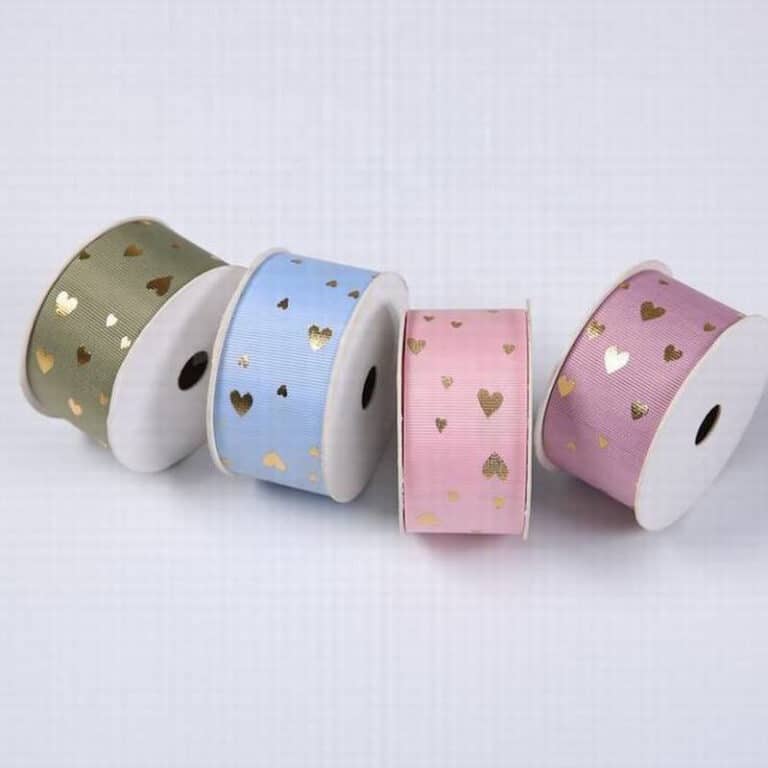
RibbonOEM decision lens: Create a program sample library with a unique code for each construction, width, shade, and decoration combination. The approval record should connect the color reference, ribbon swatch, decorated strike-off, roll-format sample, artwork version, tool reference, and buyer sign-off. Check shade and sheen across the ribbon face, edge consistency, repeat position, foil or ink coverage, roll winding, and the final tied or applied presentation. Define how repeat orders are compared when an old physical standard has aged or a raw-material lot changes.
Tie Every Satin Spec, Cost, and Risk Item to Evidence
At the point where you move from sample review to production release, the required output is a single decision asset: a documented approval record that ties every specification, cost, and risk item to verifiable evidence. Without it, the next stage—whether bulk order or reorder—starts with ambiguity.
Supplier evidence to request
Verify that the factory can produce the satin ribbon as specified. Request process documentation for weaving, dyeing, and finishing, and confirm that the supplier’s quality control steps align with your tolerance requirements. The MEEDEE Ribbon editorial team publishes B2B ribbon sourcing, customization, and sampling guidance; use that as a baseline for what proof is reasonable to expect.
Sample approval evidence
Before approving a sample, confirm that it matches the spec sheet on material, width, color, and edge finish. A woven edge sample that differs from the approved standard is a red flag. Document the approval evidence—photos, measurements, and any test results—so the decision is measurable, not subjective.
Reorder control records
Define how reorders will be controlled. Establish a checklist that includes the original approved sample, the spec sheet, and a cost review. This prevents drift in quality or pricing. For further guidance on custom ribbon programs, see our OEM and ODM ribbon manufacturing.
| Requirement | Approval Evidence | Checkpoint Action |
|---|---|---|
| Specification match | Sample vs. spec sheet comparison | Verify dimensions, material, color |
| Production risk | Process documentation | Confirm quality control steps |
| Cost and MOQ | Quoted price and MOQ terms | Review against budget and volume |
| Reorder control | Approved sample and spec archive | Set reorder review procedure |
After completing these checks, you have a decision asset that supports both the initial order and future reorders. This is the output that must exist before you proceed to production release.
Quote the Satin Program as a Controlled SKU Matrix
- Can the factory provide satin ribbon samples that match your width, color, and weave specifications? Confirms the supplier can produce to your exact technical requirements, not just generic stock. Sample matches your spec within stated tolerances; supplier documents the test method. Accepting a close but off-spec sample leads to rework and delays. Request a pre-production sample and measure against your spec sheet.
- What is the factory's standard production lead time after sample approval? Aligns your order schedule with the supplier's capacity and avoids missed deadlines. Lead time is stated in calendar days and includes conditions for custom printing or dyeing. Underestimating lead time disrupts your downstream packaging or event timeline. Confirm lead time in writing before placing the order.
- How does the factory verify color consistency across dye lots? Ensures reorders match your approved sample, preventing brand color drift. Supplier uses a color measurement system and provides a dye lot tolerance. Color variation between lots can ruin a branded program. Ask for a dye lot tolerance statement and a reorder sample policy.
- What quality control checks are performed on satin ribbon before shipment? Identifies whether the factory catches defects like fraying, uneven edges, or print misalignment. Supplier lists specific QC steps, such as visual inspection and width measurement. Defective ribbon reaches your customer, causing returns and reputation damage. Request a QC checklist and consider a pre-shipment inspection.
- Can the factory provide a comparable quote request input sheet for your custom program? Standardizes quotes across suppliers, making price and terms comparison fair. Supplier accepts your quote request format and fills in all required fields. Vague quotes hide costs or lead to misunderstandings. Send your quote request template and ask for a line-item quote.
RibbonOEM decision lens: Provide an SKU matrix with construction, width, base color, decoration, artwork, repeat, annual forecast, launch quantity, reorder quantity, roll or cut format, destination, and required date. Ask the supplier to show which SKUs share ribbon stock, which require separate dye lots or tools, how partial quantities are handled, and where sample or production lead times differ. Include shade-approval ownership, golden-sample storage, change control, packing labels, and reorder traceability so the program remains stable after the first launch.
Source check: ISO 2859-1 sampling inspection standard; How to Buy Custom Satin Ribbon A Complete Buyer s Guide – Print….
In conclusion
The final approval for your satin ribbon program rests on a disciplined review of the specification, cost, and supplier evidence. Before you commit, check that the material, width, color, printing method, and artwork version are locked in writing, and compare the MOQ and lead time against your schedule. Verify the factory’s capability through a pre-production sample, measuring shade, width, and weave density against your spec sheet. Document every decision—from the quote request to the approved sample—so that the handoff to production is seamless and traceable. Shortlist suppliers who can provide transparent proof of their process and quality controls, and request a quote that itemizes all variables. By validating the spec and approving the sample with evidence, you mitigate risk and set the stage for a reliable, repeatable order.
To request a quote for satin ribbons custom, use satin ribbons to confirm the final specification, quote assumptions, sample approval, QC evidence, approval risk, and supplier follow-up before bulk order.
Frequently Asked Questions
How should a b2b buyer plan custom order?
Start by defining the exact specification: material type, width, color, printing method, artwork version, and packing. Confirm the MOQ for each SKU, as it varies by these factors, and verify the standard production lead time of 2-4 weeks after sample approval, noting that complex custom programs can take up to 60 days. Shortlist suppliers who can document their process and provide a clear quotation.
Request a sample for QC verification, checking shade, width, weave density, and print alignment against your approved spec. Compare quotes from multiple suppliers, ensuring cost and lead time are confirmed in writing. Document all parameters in the quote request to avoid ambiguity.
Which supplier proof should buyers request for satin ribbons?
Request proof that the factory can meet your specification: a detailed spec sheet, production capability evidence, and a sample that matches your approved standard. Verify their claims by checking material composition, width tolerance, and colorfastness. Confirm the MOQ and lead time in the quotation, and ask for references or past order examples.
For risk mitigation, require a pre-production sample for approval before mass production. Check that the supplier has quality control measures in place, such as inline inspection and final QC. Document all evidence and compare it against your requirements to ensure consistency.
What should buyers lock before approving custom program planning checklist?
Lock the exact specification: material, width, color, printing method, artwork version, and packing details. Confirm the MOQ per SKU and the lead time, noting that standard production is 2-4 weeks after sample approval, but complex custom programs can take up to 60 days. Verify the cost structure, including any setup or tooling fees, and ensure it’s stated in the quote request.
Before approving, verify the sample against your spec, measuring shade, width, and print quality. Check that the supplier’s QC process is documented and that they can handle reorders with consistent quality. Approve only after you have a written confirmation of all terms, and keep a record for future reference.
quote request handoff: Send Specs for Review.
Editorial note
Prepared by the MEEDEE Ribbon Editorial Team and reviewed against current product, customization and sourcing information supplied by Meedee Ribbon Inc. Commercial terms such as MOQ, sampling and lead time should be confirmed for each specification.